
Amadumbe: Health Benefits of Science’s Newest Superfood Root
By Zama Zincume — Public Health Specialist & Plant-Based Food Writer
Quick Answer: Amadumbe (Colocasia esculenta, known internationally as taro) is a starchy root vegetable that has long been grown in KwaZulu-Natal. Laboratory studies now confirm that it contains high levels of resistant starch, meaning it behaves more like fibre than sugar in the body, along with gut-soothing mucilage and a mineral profile that includes notable levels of potassium and magnesium. The antinutrients naturally present in raw amadumbe are substantially reduced by the boiling and roasting methods already used in traditional preparation.
I grew up watching my grandmother pull amadumbe corms out of a pot, peel back the skin with her thumb, and hand me the softest piece first. Nobody in that kitchen called it a “superfood.” It was just what was for dinner.
It’s taken the scientific literature a few decades to catch up to her.
What Amadumbe Actually Is
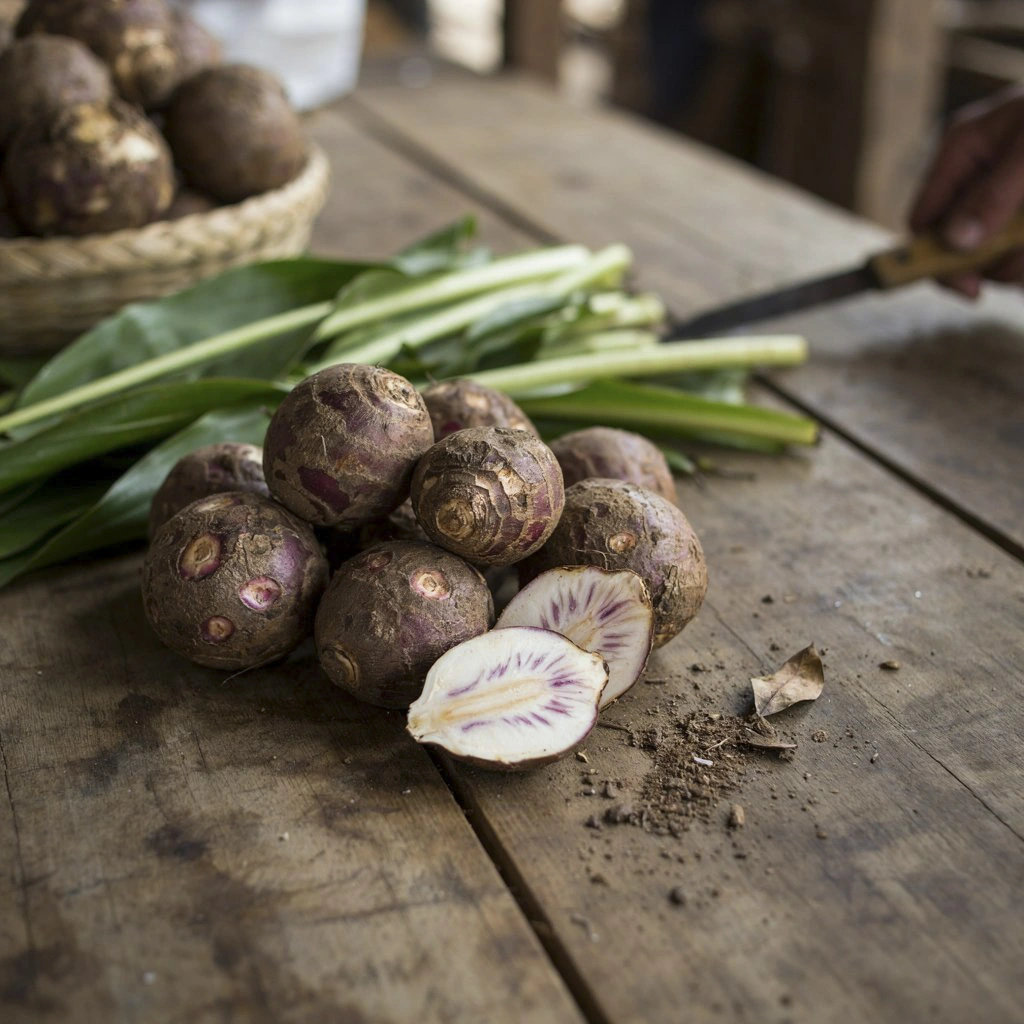
Amadumbe is the Zulu name for Colocasia esculenta, a tuber crop grown throughout subtropical and tropical regions worldwide and known internationally as taro. In South Africa, it’s cultivated mainly by small-scale farmers in KwaZulu-Natal, where it has long been part of the everyday diet in rural households.
Nutritionally, the corm is dominated by starch; typically 80–96% of its carbohydrate content, with a much smaller share of protein and fat. What makes amadumbe interesting isn’t just how much starch it has, but what kind.
The Resistant Starch Story
Most of the carbohydrate we eat – white bread, white rice, instant mielie meal – is digested quickly, which is part of why it spikes blood sugar.
Resistant starch is different: it passes through the small intestine largely undigested and behaves more like dietary fibre, feeding gut bacteria in the colon instead of being absorbed as glucose.
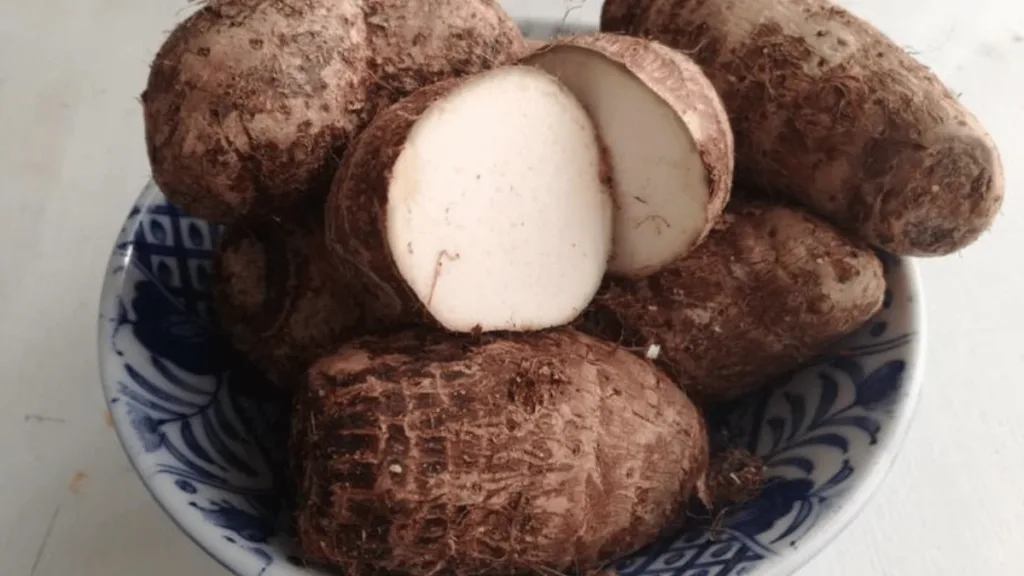
Amadumbe corms have been measured to have resistant starch content in the range of 52–64% (Naidoo et al., 2015), and a comparison of wild versus cultivated corms found that the resistant starch fraction remained at roughly 64% even after boiling and baking. In plain terms, cooking amadumbe the way it’s traditionally cooked doesn’t strip out the benefit.
A broader 2025 review of taro research describes this resistant starch, alongside the tuber’s dietary fibre and antioxidant compounds, as the basis for taro’s prebiotic, hypoglycaemic, and hypocholesterolemic properties: meaning it may support gut bacteria, help moderate blood sugar response, and support healthier cholesterol levels. This is still an emerging area of research rather than a settled clinical fact, but the direction of the evidence is consistent.
The Mucilage Most People Throw Away Their Nose At
Amadumbe corms also contain mucilage: a soluble fibre that gives the vegetable its slightly slippery texture when cooked, similar to okra. Studies place mucilage content at roughly 7–10% of the corm (pubs.sciepub.com, 2022), and this soluble fibre is associated with digestive health benefits.
It’s worth saying plainly: the texture that puts some people off is the same compound doing useful work in the gut.
What About the Antinutrients?
Raw amadumbe contains antinutrient compounds: oxalates, phytates, tannins, and others, which is part of why nobody eats it raw.
A KwaZulu-Natal-based study evaluating local amadumbe phenotypes confirmed the presence of these compounds, as well as the crop’s carbohydrate, protein, and mineral content.
The same study noted amadumbe’s relatively high potassium and magnesium levels and pointed to potential benefits for people managing diabetes and hypertension, though this is early-stage evidence, not a treatment claim, and shouldn’t be read as medical advice.
The practical point for the kitchen: traditional preparation, thorough boiling, sometimes with a change of water, is exactly the kind of processing known to reduce antinutrient load in root vegetables generally. Grandmothers were not being cautious for no reason. They were running a food safety protocol several generations before anyone wrote it down in a journal.
Where Amadumbe Fits in a Staple-First Kitchen
This is the part that matters more than any lab result: amadumbe is cheap, filling, and already familiar to South African households. It doesn’t require a speciality health-food aisle or an imported substitute. It requires a pot of water and time, the same requirement it’s had for generations.
A few practical ways to work it into a plant-based week:
- Boiled and mashed as a potato alternative, finished with a little onion and chilli
- Added to stews in place of some or all of the potato, where its starch helps thicken the pot
- Roasted in wedges after boiling, for a crisper side dish
- Paired with morogo and beans for a full plate that leans on three indigenous staples at once rather than one imported “superfood”
This is the core idea behind the Staple-First Method™: reach for what already grows here and what your family already knows how to cook, before reaching for an imported plant-based product with a longer ingredient list and a higher price tag.
Key Takeaways
Amadumbe (taro / Colocasia esculenta) is a traditional KwaZulu-Natal root vegetable now being studied for its resistant starch content (52–64%), which behaves more like fibre than sugar in digestion.
- Its mucilage content (7–10%) is a soluble fibre associated with gut health benefits.
- Traditional boiling preparation is consistent with reducing the antinutrient compounds naturally present in the raw corm.
- Early research points to prebiotic and blood-sugar-moderating properties, though this remains an active, developing area of study rather than settled clinical guidance.
- Amadumbe fits the Staple-First Method™ approach: affordable, local, and already part of South African food culture.
This article is for educational purposes and does not constitute medical advice. If you’re managing diabetes, hypertension, or another condition, speak with your doctor or a registered dietitian before making significant dietary changes.
Frequently Asked Questions
Is amadumbe the same as taro?
Yes. Amadumbe is the Zulu name for Colocasia esculenta, which is known internationally as taro. It’s the same plant, prepared according to South African tradition, specifically KwaZulu-Natal tradition.
Is amadumbe good for blood sugar?
Amadumbe’s high resistant starch content means it’s digested more slowly than many refined starches, which is associated with a gentler blood sugar response. This is based on early nutritional research rather than large-scale clinical trials, so it should be treated as a promising area of evidence, not a guarantee for individual health outcomes.
Can you eat amadumbe raw?
No. Like most root vegetables in this family, amadumbe should be thoroughly cooked. Raw corms contain antinutrient and irritant compounds that are substantially reduced by boiling, which is exactly why traditional preparation always cooks them thoroughly before eating.
Where can I buy amadumbe in South Africa?
Amadumbe is available at many traditional and informal markets and, increasingly, in the fresh produce sections of some major supermarkets. Availability is strongest in KwaZulu-Natal, where it is most widely grown.
Sources & Further Reading
- Naidoo, K. et al. (2015) — resistant starch content of amadumbe corms (52–64%), cited via: Composition, pasting and thermal properties of flour and starch derived from amadumbe with different corm sizes, PMC — https://pmc.ncbi.nlm.nih.gov/articles/PMC7447738/
- In-vitro digestibility and physicochemical properties of starch from wild and cultivated amadumbe corms — ScienceDirect — https://www.sciencedirect.com/science/article/abs/pii/S0144861715001836
- Influence of Genotypes and Environment on Physicochemical Properties of Taro (Colocasia esculenta) Starch — starch and mucilage content ranges — https://pubs.sciepub.com/jfnr/10/9/1/index.html
- From starch to bioactives: emerging trends in taro (Colocasia esculenta) research on composition, functionality, health benefits and sustainable food potential — Frontiers in Nutrition (2025) — https://www.frontiersin.org/journals/nutrition/articles/10.3389/fnut.2025.1640156/full
- Anti-nutritional constituent of Colocasia Esculenta (Amadumbe): a traditional crop food in KwaZulu-Natal — Knowledge Hub / CCARDESA — https://www.knowledgehub.ccardesa.org/anti-nutritional-constituent-colocasia-esculenta-amadumbe-traditional-crop-food-kwazulu-natal