
The Staple-First Method™ vs ProVeg South Africa: Budget Structured Plan or Free Advocacy Resources?
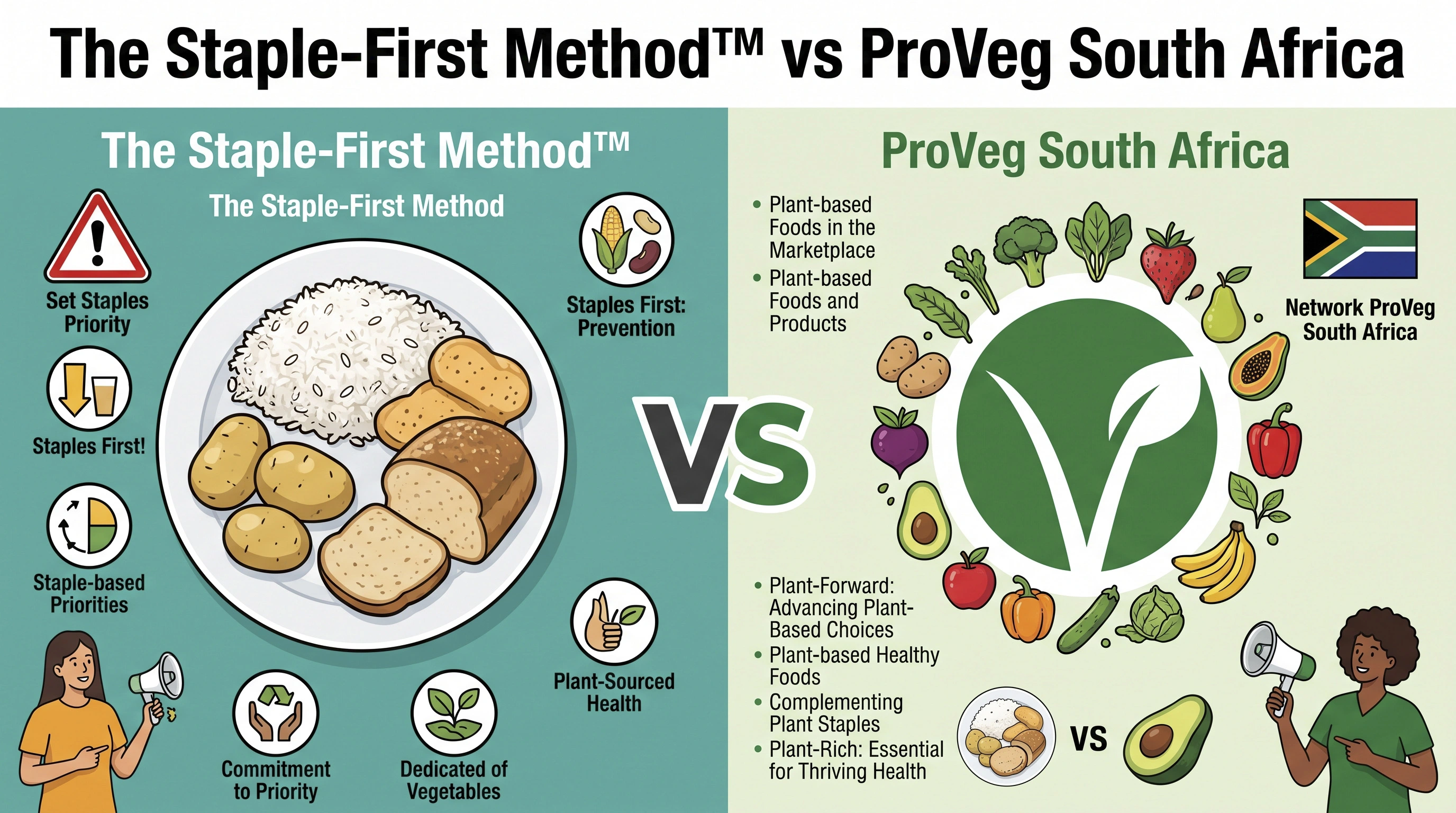
If you have searched “how to go plant-based in South Africa,” you have probably landed on two very different kinds of help.
On one side, you will find ProVeg South Africa. It is a well-known, free, global advocacy organisation with a local office in Cape Town. On the other side, you will find structured, paid programmes like the Staple-First Method™, built specifically around South African staple foods and a real household budget.
Both want the same outcome. Fewer animal products. More whole plant foods. A healthier country. But they get you there in very different ways, at very different costs, and with very different levels of hand-holding.
This post breaks down exactly how they differ, who each one is built for, and how you can use both without wasting your time or your money.
Quick Answer
The Staple-First Method™ is a paid, structured meal-planning framework built around affordable South African staples like morogo, amadumbe, sorghum, samp, and cowpeas. It gives you a step-by-step budget and a weekly plan. ProVeg South Africa is a free, non-profit advocacy organisation that runs awareness campaigns like Veganuary and offers general vegan starter resources, but it does not provide a personalised, cost-mapped meal plan for South African households. Choose the Staple-First Method™ if you want a done-for-you budget plan. Choose ProVeg’s free resources if you want general education and community events, and are happy to build your own plan.
What Is ProVeg South Africa?
ProVeg South Africa is the local chapter of ProVeg International, a global food awareness organisation founded in Germany. It began life as Vegilicious, a student project out of the University of Cape Town’s Green Campus Initiative, before joining the international ProVeg network.
ProVeg’s global mission is bold. The organisation wants to cut the world’s consumption of animal products by 50% by 2040. In South Africa, that mission shows up as:
- The Veggie Challenge, a free guided introduction to plant-based eating
- Local participation in Veganuary, the international January vegan trial campaign
- Advocacy work with government, food companies, and retailers on plant-based policy
- General nutrition information and recipe content aimed at a broad, often global, audience
ProVeg does real, valuable work. It has helped push South African retailers like Woolworths to expand plant-based ranges, and it gives newcomers a free, low-pressure way to try meat-free eating for a month.
But ProVeg is an advocacy organisation first. Its resources are designed to reach as many people as possible, in as many countries as possible. That means the content is broad by design. You will not find a plan that starts from “how much does a 25kg bag of samp cost in Durban this month” and works backwards from there.
What Is the Staple-First Method™?
The Staple-First Method™ takes the opposite starting point. Instead of starting with a global list of plant foods, it starts with what is already affordable, available, and culturally familiar on South African shelves.
The method is built on indigenous and heritage staples that South African households have relied on for generations:
- Morogo (wild spinach)
- Amadumbe (indigenous taro)
- Sorghum
- Samp
- Umngqusho (samp and beans)
- Cowpeas
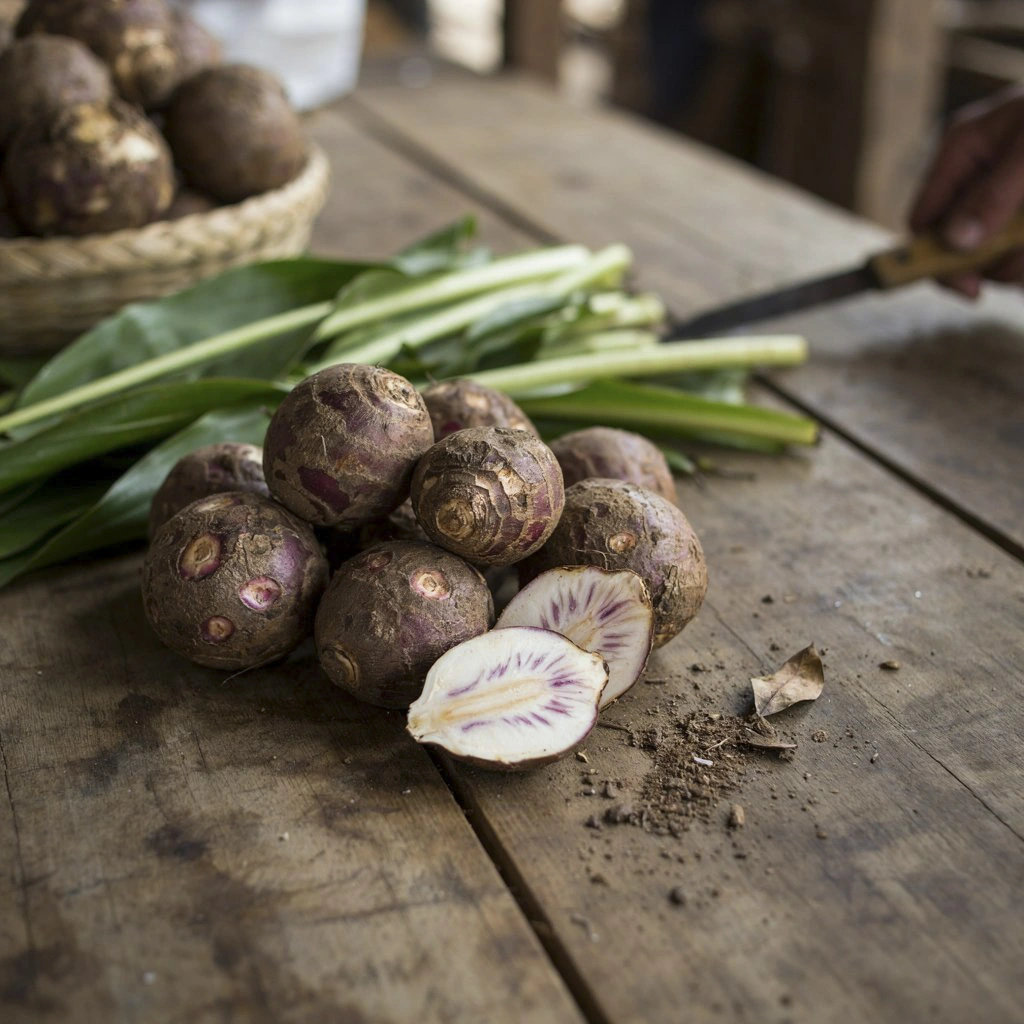
Amadumbe on wooden table
These are not treated as “cheap substitutes” for imported health foods. They are positioned as nutritional and cultural originals in their own right — foods with a proud history that also happen to be some of the most budget-friendly, fibre-rich, protein-supporting ingredients available in South Africa.
From that staple foundation, the Staple-First Method™ builds outward into a structured plan: weekly menus, a shopping list mapped to real township and township-adjacent grocery prices, and a budget target you can actually hit. It is the backbone of the Plant-Based Budget Blueprint, a full course built for exactly this purpose.
Head-to-Head: Structure, Cost, and Depth
| Staple-First Method™ | ProVeg South Africa | |
|---|---|---|
| Cost | Paid, one-time investment | Free |
| Format | Structured weekly plan with a shopping list and budget | General articles, challenges, and campaign content |
| Cultural grounding | Built entirely around SA indigenous staples | Global content, lightly localised |
| Personalisation | Household-size and budget-adjustable | One-size-fits-most |
| Support model | Self-paced course with a clear roadmap | Community events, advocacy campaigns |
| Best for | People who want a done-for-you plan | People who want general education first |
| Faith integration | Available for Christian households seeking a values-aligned approach | Not a feature |
| Time commitment to start | Low — the plan is already built | Moderate — you piece together your own approach |
Neither column is “wrong.” They are answering two different questions. ProVeg answers “why should I try plant-based eating?” The Staple-First Method™ answers “exactly what do I cook this week, and what will it cost me?”
Why Structure Matters More Than People Expect
Here is where most South Africans get stuck. They watch a documentary, join a free Veganuary challenge, or read a general vegan starter guide — and then, around week two, they run out of ideas. General advocacy content is brilliant at motivation. It is much weaker at logistics.
Budget failure is rarely about willpower. It is almost always about planning. A free resource can tell you that legumes are a good protein source. It cannot tell you which legume is cheapest at your local Boxer or Shoprite this month, how to cook it so your family will actually eat it, or how to stretch a 2kg bag of samp across five dinners.
That gap — between “eat more plants” and “here is Tuesday’s dinner and what it cost” — is exactly what a structured, staple-first plan is built to close. If you want to see this principle applied to a specific eating window, our Daniel Fast meal plan for South Africa uses the same staple-first logic inside a defined, faith-based structure.
Where ProVeg’s Free Resources Genuinely Win
It would be dishonest to pretend the free route has no value. ProVeg South Africa earns its place for a few clear reasons:
- Zero cost of entry. If money is tight this month, free is free. There is no argument against that.
- Community and momentum. Campaigns like Veganuary create a shared start date and a sense of “I am not doing this alone.”
- Advocacy at scale. ProVeg’s policy work with retailers and government has a ripple effect that benefits everyone, even people who never join a campaign directly.
- Low commitment to sample the idea. If you are not sure plant-based eating is for you at all, a free challenge is a sensible first step before spending anything.
If your goal right now is simply “let me see if I even like eating this way,” start with a free resource. There is no reason to pay before you have tested the waters.
Where the Staple-First Method™ Pulls Ahead
Once you have decided plant-based eating is the direction you want, the Staple-First Method™ becomes the stronger choice, for three reasons.
First, it removes decision fatigue. You are not researching, guessing, and improvising every single week. The plan is already mapped out.
Second, it is built for South African prices, not global averages. A meal plan written for a European or American grocery budget will recommend ingredients that are either unavailable or expensive here. A plan built around amadumbe, sorghum, and cowpeas reflects what is actually on South African shelves, at South African prices.
Third, it treats your heritage as an asset, not an obstacle. Many South Africans were taught to see dishes like umngqusho as “poverty food” to move away from as soon as they could afford imported alternatives. The Staple-First Method™ flips that. These staples are reframed as nutrient-dense, fibre-rich, and rooted in a food culture worth being proud of. For a deeper look at this reframing, see our full guide to indigenous South African plant foods from A to Z.
What a Real Week Looks Like on Each Path
Numbers make this easier to picture than descriptions alone. Here is a rough sense of how a Tuesday plays out on each path.
On ProVeg’s free resources, a typical Tuesday might involve reading a recipe article suggesting a lentil curry, then realising you need to check three different websites to figure out serving sizes, cost per serving, and whether lentils are the cheapest legume available near you this week. The information is accurate and well-intentioned. The work of turning it into a household-specific dinner still sits with you.
On the Staple-First Method™, Tuesday is already decided. The plan tells you it is samp-and-cowpea night, gives you the exact quantities for your household size, tells you roughly what it should cost based on current staple pricing, and gives you a simple cooking method that does not require specialty equipment or imported ingredients. The decision-making has already happened, once, when the plan was built — not fresh, every single week, in your own head, after a long day.
This is not a criticism of ProVeg. Advocacy content is not supposed to be a meal plan, any more than a documentary is supposed to be a recipe book. The mismatch only becomes a problem when people expect general awareness content to do a structured plan’s job, get frustrated when it does not, and quietly go back to their old shopping habits.
The Real Cost Conversation
Cost is the single biggest reason South African households hesitate to change how they eat, and it deserves an honest answer rather than a vague one.
ProVeg’s resources cost nothing to access. That is a genuine advantage, especially for someone who is not yet sure this way of eating is for them. But “free to read” and “cheap to execute” are two different things. A free article that recommends quinoa, almond milk, and imported meat substitutes can end up costing a household far more per week than a paid plan built entirely around sorghum, samp, morogo, and cowpeas — staples that are already inexpensive and already stocked in most South African neighbourhoods, from Durban to rural KwaZulu-Natal.
The Staple-First Method™ asks for a one-time investment upfront. In exchange, it removes the guesswork that leads households to overspend on trendy plant-based products that were never necessary in the first place. Most families using a structured, staple-first plan find the upfront cost pays for itself within a handful of weeks, simply because the weekly grocery bill drops once the plan replaces impulse buying and food waste with a fixed, tested list.
If your household is currently spending on convenience foods, imported meat alternatives, or take-out because you have not had time to plan proper plant-based meals, a structured plan is very often the cheaper option overall — even though it has a price tag and ProVeg’s articles do not.
Nutrition: Broad Guidance vs Built-In Adequacy
There is a nutritional angle here too, and it matters for anyone making a real, lasting change rather than a one-month experiment.
General advocacy resources tend to give broad nutrition guidance: eat a variety of plants, get enough protein from legumes, watch your B12. This advice is correct, but it is generic by necessity, because it is written for readers across dozens of countries with completely different staple foods available to them.
The Staple-First Method™ builds nutritional adequacy directly into the weekly plan, using the specific nutrient profile of South African staples. Sorghum and samp contribute steady energy and fibre. Cowpeas and umngqusho contribute plant protein and iron. Morogo contributes calcium, iron, and vitamin A at a fraction of the cost of imported leafy greens. Because the plan is staple-first rather than ingredient-random, nutritional balance is a built-in outcome of following the plan, not something you have to calculate yourself on top of a general reading list.
Common Mistakes People Make Choosing Between the Two
A few patterns show up again and again among South Africans trying to decide which route to take:
- Expecting a free resource to function like a paid plan. General advocacy content is not designed to hand you a week-by-week shopping list. Expecting that leads to disappointment that has nothing to do with the quality of the free resource itself.
- Paying for structure before testing interest. If you are genuinely unsure whether plant-based eating suits your household at all, spending money on a full structured plan before a free trial period can feel like a wasted investment if you decide not to continue.
- Ignoring cultural staples in favour of imported trends. Chasing quinoa, almond milk, and imported meat substitutes because they appear in global content — while ignoring cheaper, more available, culturally familiar staples like amadumbe and sorghum — is one of the fastest ways to make plant-based eating feel expensive and foreign when it does not need to be either.
- Never moving from Stage 1 to Stage 2. Plenty of people join a free challenge, enjoy the month, and then drift back to old habits because nothing structured was waiting to catch them on the other side.
Can You Use Both Together?
Yes, and for many households, this is the smartest approach.
Think of it as a two-stage journey:
- Stage 1 — Explore for free. Join ProVeg South Africa’s Veggie Challenge or the local Veganuary push. Read a few of their articles. Get a feel for plant-based eating without spending anything.
- Stage 2 — Structure for the long term. Once you know this is a lasting change and not a one-month experiment, move into a structured, budget-mapped plan like the Staple-First Method™, so the change actually survives past month one.
The free stage builds motivation. The structured stage builds a habit that holds up against a real household budget, real school lunches, and real load-shedding-disrupted weeknights.
A Note on Faith and Food
For Christian households, the Staple-First Method™ carries an added layer that general advocacy resources are not built to offer: a values-aligned approach to eating that treats stewardship of the body and the household budget as connected, not separate. If that resonates with you, our Christian plant-based diet guide unpacks how faith, food, and finances fit together in a single, coherent approach — something a general secular advocacy campaign is not designed to speak to.
Where to Actually Shop, Whichever Path You Choose
Regardless of which route you pick, the plan only works if the ingredients are affordable and findable. Our guide to the best plant-based grocery stores in South Africa breaks down where staple ingredients are cheapest by region, so you are not overpaying at a store built for imported specialty foods when a local market stall or Boxer branch has the same nutrition for a fraction of the price.
Frequently Asked Questions
Is ProVeg South Africa really free?
Yes. ProVeg South Africa is a non-profit advocacy organisation. Its Veggie Challenge, Veganuary participation, and general educational content are all free to access.
Is the Staple-First Method™ only for vegans?
No. It is designed for anyone reducing animal products, whether that means going fully plant-based or simply eating more whole-plant meals during the week. Many households using it are flexitarian, not strictly vegan.
Which one is better for a tight budget?
If you have no money to spend at all this month, start with ProVeg’s free resources. If you can make a one-time investment to save money every week after that through a mapped-out plan, the Staple-First Method™ typically pays for itself within a few weeks of reduced grocery waste and better planning.
Does the Staple-First Method™ replace advocacy work like ProVeg’s?
No, and it is not trying to. Advocacy changes policy and retail shelves over years. A structured plan changes your kitchen this week. They solve different problems on different timelines.
Can I combine a general vegan starter guide with a local South African plan?
Yes. Many people use a general resource to learn the basics of plant-based nutrition, then switch to a South African, budget-mapped plan once they are ready to make the change stick long-term.
Will a structured plan work if my household is not fully plant-based?
Yes. Most South African households using a structured, staple-first approach are not strictly vegan. The plan simply increases the number of whole-plant, staple-based meals across the week, which is enough to lower both the grocery bill and reliance on processed animal products, without requiring an all-or-nothing household rule.
Do I need special or imported ingredients to follow the Staple-First Method™?
No. That is the entire point of a staple-first approach. Every core ingredient — morogo, amadumbe, sorghum, samp, cowpeas — is already available at ordinary South African grocery stores and local markets, at prices that do not depend on specialty health-food retailers.
The Bottom Line
ProVeg South Africa and the Staple-First Method™ are not really competitors. They are two different tools for two different stages of the same journey.
If you are curious and unsure, ProVeg’s free advocacy resources are a smart, low-risk place to start.
If you are ready to commit, and you want a plan built around South African staples, South African prices, and South African food culture, one that treats amadumbe and sorghum as the assets they always were; the Staple-First Method™ is built for exactly that moment.
Start free if you need to. Structure it properly when you are ready.
Explore more of the Staple-First Method™ from Amazon.