
Brown Rice and Sautéed Cabbage Recipe
WFPB, oil-free brown rice and sauteed cabbage recipeHere’s your WFPB, oil-free brown rice and sauteed cabbage recipe.
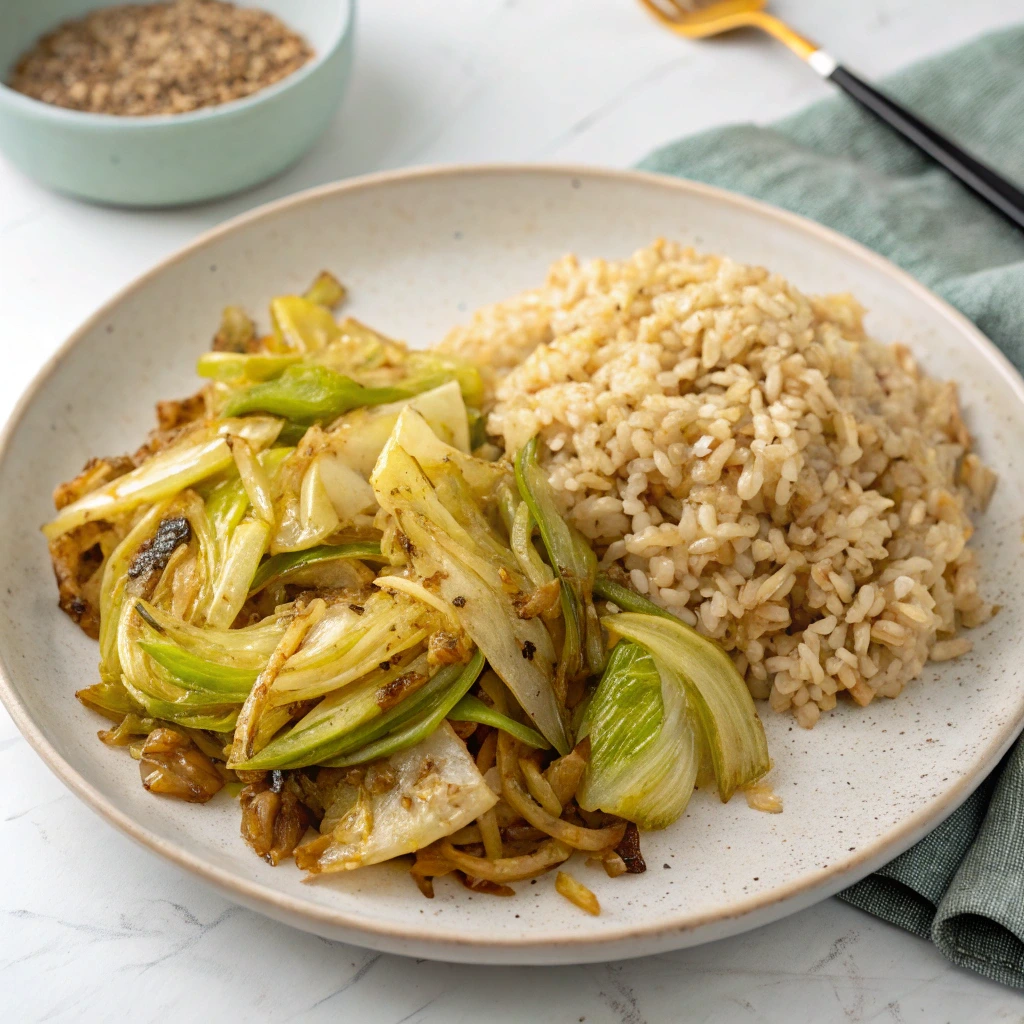
This recipe avoids oil by relying on a small amount of water or vegetable broth for sautéing, in line with typical WFPB recommendations.
Yields: 4 Servings
Prep time: 10 minutes
Cook time: 35-40 minutes
Ingredients
For the Brown Rice
- 1 cup uncooked short or long-grain brown rice
- 2 cups water or low-sodium vegetable broth (or follow package instructions)
For the Cabbage & Flavour Base:
- 1 medium head of green cabbage, cored and thinly sliced
- 1 medium yellow onion, diced
- 3-4 cloves garlic, minced
- 1 cup low-sodium vegetable broth (for water sautéing)
- 1 tablespoon apple cider vinegar or lemon juice (adds brightness)
- 1 teaspoon smoked paprika
- 1/2 teaspoon turmeric powder
- 1/4 teaspoon black pepper
- Pinch of red pepper flakes (optional, for heat)
- Salt substitute or a small amount of low-sodium soy sauce/tamari/coconut aminos to taste
Instructions
1. Cook the Brown Rice
- Rinse the brown rice under cold water.
- Combine the rice and water/broth in a pot. Bring to a boil, then reduce the heat to low, cover, and simmer for 35-40 minutes, or until all the liquid is absorbed and the rice is tender.
- Once cooked, turn off the heat and let it steam, covered, for 10 minutes. Fluff with a fork.
2. Prepare the Sautéed Cabbage
- Heat a large, non-stick pot or skillet over medium-high heat. Add the diced onion and a splash of vegetable broth (about 1/4 cup) to prevent sticking (water-sautéing). Cook for 5-7 minutes until soft and translucent. Add more broth as needed.
- Add the minced garlic and cook for about 1 minute until fragrant.
- Add the thinly sliced cabbage and the remaining vegetable broth (about 3/4 cup). Stir well.
- Cover the pot and let the cabbage steam and wilt for 5-8 minutes.
- Remove the lid. Stir in the smoked paprika, turmeric, black pepper, and red pepper flakes (if using).
- Cook uncovered for another 5-10 minutes. Stir occasionally. The cabbage should be tender but still have a slight bite, or until it’s as tender as you like. The broth should mostly evaporate.
3. Combine and Serve
- Stir the cooked and fluffed brown rice directly into the pot with the cabbage. Mix thoroughly to combine the flavours.
- Stir in the apple cider vinegar or lemon juice.
- Taste and adjust the seasoning. Use your favourite salt substitute or a little low-sodium soy sauce or tamari.
- Serve warm!
WFPB Nutritional Boosters & Variations
- Protein: Add a can of rinsed and drained black beans or lentils to the cabbage mixture for a complete meal protein profile.
- Greens: Stir in a few handfuls of chopped kale or spinach during the last 5 minutes of cooking.
- Fats (Healthy, Whole-Food): Add a sprinkle of toasted sesame seeds or some chopped walnuts/pecans. These provide healthy omega-3 fatty acids and wholesome fats.
- Umami: Add nutritional yeast (1-2 tablespoons) for a cheesy, savoury flavour, or a spoonful of miso paste dissolved in a little warm water.
Estimated Nutritional Information (Per Serving)
This estimate is based on the core ingredients:
1/4 cup uncooked (or 1 cup cooked) brown rice, 1/4 medium head of cabbage, 1/4 medium onion, one clove of garlic, 1/4 cup broth, and the spices. It assumes no added salt, oil, or sugar (WFPB-compliant).
| Nutrient | Original Recipe (Approx.) | New Recipe (with Lentils) (Approx.) | Impact on WFPB Goals |
| Calories (kcal) | approx 250 – 280 | approx 310 – 340 | Modest increase for a full meal. |
| Protein (g) | approx 6 – 7 g | approx 13 – 14 g | Doubled. Excellent source of complete plant protein for muscle and satiety. |
| Total Fat (g) | approx 2 g | approx 2.5 g | Still Very Low (WFPB core principle). |
| Carbohydrates (g) | approx 50 – 55 g | approx 60 – 65 g | Complex carbs from three sources: whole grain, cruciferous, and legume. |
| Significant boost to plant-based iron intake (essential for energy). | approx 7 – 8 g | approx 13 – 15 g | Nearly doubled. Provides about 50% of the recommended daily fibre intake. |
| Iron (mg) | Moderate | Good Source | Lentils are packed with folate (a B vitamin). |
| Folate (mcg) | Moderate | Excellent Source | Nearly doubled. Provides about 50% of the recommended daily fibre intake. |
Note on Spices: Spices (paprika, turmeric, black pepper) contribute negligible calories/macronutrients but provide significant phytonutrients and antioxidants (like curcumin from turmeric and carotenoids from paprika), which are central to the evidence-based health benefits of a WFPB diet.
Alignment with Evidence-Based WFPB Principles
This recipe fits well with the main ideas of an evidence-based, whole food, plant-based diet:
1. High Fibre Intake
- Brown rice is a whole grain, and cabbage is a cruciferous vegetable. Together, they provide a lot of dietary fibre—about 7 to 8 grams per serving. Fibre helps digestion, stabilises blood sugar, and promotes a feeling of fullness. This supports weight management.
2. Low Energy Density, High Nutrient Density
- The meal is low in calories for its size. This is mainly due to cabbage’s high water content and its lack of oil. However, it is rich in micronutrients such as Vitamin C, Vitamin K, B Vitamins, Magnesium, and Manganese.
3. Minimal Added Salt, No Added Oil
- The oil-free sautéing method, along with low-sodium broth and spices, helps keep the meal low in saturated fat and sodium. This is important for heart health on a WFPB diet.
4. Antioxidants and Anti-Inflammatory Compounds
- Cabbage is rich in glucosinolates (studied for their cancer-protective properties) and antioxidants.
- Turmeric contains curcumin, which is known for its potent anti-inflammatory effects. Adding black pepper is a wise choice. The compound piperine in black pepper enhances the body’s absorption of curcumin.