
Where to Buy Tempeh in South Africa: Your Guide
By Zama Zincume — Public Health Specialist & Plant-Based Food Writer ·
Quick answer: You can buy tempeh in South Africa at Woolworths, which stocks its own PlantLove™ Tempeh (220 g) in the plant-based protein fridge, the only mainstream supermarket that reliably carries it. Beyond that, specialist online stores deliver nationwide: Tabu Food (roughly R52–R75 across its tempeh range), Wildsprout, Liveable and Vegan Protein. For fresh, handcrafted tempeh, go direct to small makers like Boemboe Tempeh in Cape Town or Green Heart Organics in Pinetown, KZN. Expect to pay roughly R50–R80 for a 200–350 g block. One catch worth knowing before you order: most tempeh is frozen or chilled, so cold-chain delivery is often limited to major metros.
Key takeaways
- Woolworths is your easiest option. PlantLove™ Tempeh, 220 g, in the plant-based section near the meat fridges. Pick n Pay, Checkers and SPAR do not reliably stock it.
- Online specialists have the best range — including chickpea tempeh, black bean tempeh and ready-marinated patties you will never find in a supermarket.
- Cold chain is the hidden constraint. Tempeh ships frozen or chilled. Some retailers only deliver cold items to Gauteng and Cape Town, and some impose a minimum order value.
- Expect R50–R80 per block. That works out more expensive per gram of protein than soy mince or dry beans — but cheaper than most seitan and almost all mock meats.
- Do not buy tempeh for vitamin B12. Several South African retailers claim that tempeh is an excellent source of B12. The evidence does not support this, and I explain why below. It is a superb food for many other reasons.
- Tempeh is naturally gluten-free — the key practical difference from seitan, which is pure wheat gluten.
What is tempeh, exactly?
Short answer: Tempeh is a firm, nutty cake of whole soybeans bound together by an edible fungus (Rhizopus oligosporus) through natural fermentation. It originated in Indonesia; it is a complete protein containing all nine essential amino acids, and unlike tofu, it uses the whole bean — which means it keeps its fibre.
If you have walked past tempeh in the fridge and assumed it was a strange-looking tofu, you are not alone. But they are genuinely different foods.
Tofu is made by curdling soy milk and pressing it; the bean is strained, so much of the fibre is removed. It is soft and mild, and takes on whatever flavour you give it.
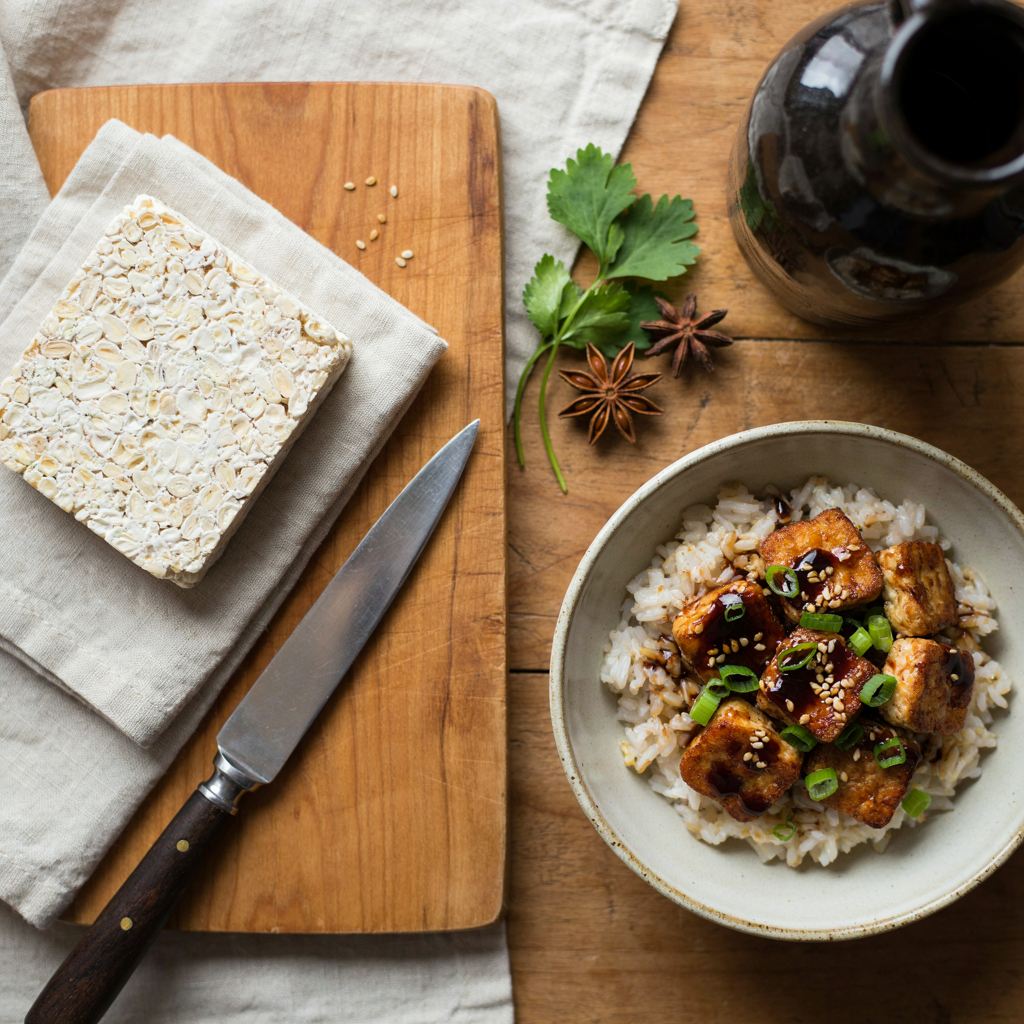
Tempeh is made by cooking whole soybeans, inoculating them with a Rhizopus culture, and letting them ferment until the mould knits the beans into a solid, sliceable cake. You can see the individual beans. It has a firm bite and a savoury, nutty, faintly mushroomy flavour of its own.
Seitan, by contrast, is not soy at all, it is wheat gluten. That makes it the highest in protein of the three, but entirely off-limits for anyone with coeliac disease or gluten sensitivity. If that is you, tempeh is your answer. (I cover the wheat-based option in full in my guide to where to buy seitan in South Africa.)
Because tempeh is fermented, it is also easier to digest than plain soybeans. Fermentation breaks down some of the compounds that cause bloating and reduces phytates, which can improve your body’s absorption of minerals like iron and zinc.
Why tempeh deserves a place in a South African kitchen
Short answer: Tempeh is a whole food, not a processed mock meat. It is dense enough to satisfy a braai-culture appetite, takes a marinade beautifully, and fits South African flavour profiles: curry, chakalaka, peri-peri, and bobotie spicing, better than almost any imported meat substitute.
I have written a great deal about how plant-based eating in South Africa works best when it starts with staples; samp, beans, lentils, morogo, rather than expensive imports.
So let me be honest and consistent: tempeh is not a budget staple. Nothing at R60 a block is.
But it earns its place for three reasons.
First, it is a whole food. Most plant-based “meat” on South African shelves is heavily processed: isolates, starches, gums, flavourings. Tempeh is beans and a culture. That is it. If you are trying to eat a genuine whole-food plant-based diet rather than a vegan junk-food diet, tempeh is one of the very few convenient proteins that qualify.
Second, it holds up on the fire. This matters more in Mzansi than almost anywhere. Tofu falls apart on a braai grid. Tempeh does not. Slice it thick, marinate it, and it chars beautifully.
Third, it takes our spices. Tempeh’s nutty base flavour is a friend to strong seasoning. A bobotie-spiced tempeh mince, a peri-peri tempeh skewer, a curry with tempeh cubes instead of chicken, these work. They are not sad substitutions.
Treat it as the occasional protein you enjoy, on top of a foundation of cheap staples. That is exactly how I use it, and it is how it stays affordable.
Where to buy tempeh in South Africa: the complete 2026 list
Short answer: Three routes. Woolworths for convenience, specialist online vegan stores for range and nationwide delivery, and small local makers for the freshest product. Health shops and Asian grocers are worth a look but are inconsistent.
1. Mainstream supermarkets
Woolworths — the one that actually stocks it
Woolworths sells PlantLove™ Tempeh (220 g) under its own label. This is the single most accessible tempeh in the country, and if you are new to it, this is where I would start.
Useful details from the packaging:
- 220 g block, vegan and Halaal-certified
- Uncooked, previously frozen — keep it refrigerated once you buy it
- Filed under plant-based protein, near the meat and poultry fridges, not with the health foods
- Woolworths suggests sautéing, baking, mincing, braaiing, or adding it to sauces, soups and stews
Price: R69.99 — check in store or on the app, as it moves with promotions. Tempeh appears in their plant-based promotional bundles fairly often, so it is worth watching for a multi-buy.
My tip: stock is patchy at smaller Woolworths Food stores. Use the “Check In-store Availability” tool on their site before you drive.
Pick n Pay, Checkers, SPAR and Dis-Chem
Here is the honest picture: you cannot rely on any of these for tempeh in 2026.
All of them have expanded their plant-based ranges considerably — you will find Fry’s, The Vegetarian Butcher, Herbivore and plenty of tofu. But tempeh is a slower-moving, cold-chain product with a niche following, and it has not made the leap into their standard ranges nationally.
You may get lucky at a flagship urban store. Do not plan a meal around it. If a reader has found tempeh consistently stocked at a Checkers or Pick n Pay near them, tell me in the comments and I will update this guide.
2. Specialist online stores (best range, nationwide)
This is where tempeh really lives in South Africa. If you want variety — chickpea tempeh, black bean tempeh, marinated patties — you are shopping online.
Tabu Food
Tabu Food is an organic, plant-based and macrobiotic specialist, and it has the deepest tempeh range I have found in the country. Their line-up includes:
- Plain soybean tempeh
- Tempeh burger patties
- Tempeh kofte
- Black bean tempeh
- Natto (a different fermented soy product, if you are feeling adventurous)
Price: roughly R52 – R75 across the range, depending on the product.
⚠️ Read this before you order. Tabu’s cold products, which include all tempeh; are only delivered to Pretoria, Johannesburg and Cape Town, and there is a minimum combined cold order of R500. If you are in Durban, Gqeberha, Bloemfontein or a smaller town, this one is not for you. Plan a bulk order with friends if you are in a covered metro.
Wildsprout
Wildsprout sells a 220 g tempeh made from non-GMO organic soybeans, Rhizopus cultures and rice vinegar. It is a clean, short ingredient list — exactly what you want.
It is sold frozen. Their guidance: keep it frozen, do not refreeze after thawing, and use within 10 days of refrigeration. Price: R52.00.
Liveable
Liveable runs a dedicated tempeh and tofu category and carries several brands, which makes it a useful place to compare in one basket.
Vegan Protein
Vegan Protein stocks tempeh and offers free in-store pickup or delivery across South Africa. They position themselves as non-GMO and locally sourced.
3. Local artisan makers (freshest product, best flavour)
This is my favourite category, and the one most people miss. Fresh, handmade tempeh from a small producer is a completely different eating experience from a frozen block; denser, nuttier, more alive.
Boemboe Tempeh / TempehSA — Cape Town
Boemboe Tempeh (also trading as TempehSA) is an Indonesian tempeh specialist, handcrafting in Cape Town using locally sourced beans. This is tempeh made by people who take it seriously as a food tradition, not as a meat substitute.
Their range goes well beyond a plain block — tempeh chips, chickpea tempeh, black bean tempeh, patties, BBQ tempeh, and a bobotie tempeh that is exactly the kind of cultural crossover I love to see. They indicate reach into Pretoria, Durban, Johannesburg, and Cape Town.
Green Heart Organics — Pinetown, KZN
Good news for us in KwaZulu-Natal, where the online cold-chain restrictions bite hardest. Green Heart Organics sells a 350 g soybean tempeh; a notably larger block than the 220 g standard — from a Pinetown depot, online orders only. Non-GMO and all-natural.
(A note on their product page: it describes tempeh as “one of the best vegetarian B12 sources.” That is a widely repeated claim, and it is not correct. See the section below, it is important enough that I am not going to let it slide, even when I am recommending the shop.)
4. Health shops and Asian grocers
Independent health stores, organic markets and Asian supermarkets sometimes carry tempeh, particularly in Cape Town, Durban and Johannesburg. It is worth a phone call, but it is inconsistent enough that I cannot confidently list specific branches.
The Vegan SA directory maintains a tempeh listing that is useful for spotting smaller regional suppliers.
5. Make your own
Tempeh is genuinely home-makeable, and it is dramatically cheaper, you need soybeans (or almost any bean), a starter culture, vinegar and a warm, stable environment around 30 °C for roughly 24–36 hours.
Starter cultures can be ordered online. The main challenge in South Africa is temperature stability, especially with load-shedding making an incubator unreliable. A polystyrene box with a hot water bottle works surprisingly well.
Homemade tempeh brings the cost down to roughly the price of the beans, under R20 a block. If you are cooking for a family and tempeh has become a regular, this is the move. I will cover the full method in a dedicated guide.
Tempeh prices in South Africa: what you should expect to pay
Short answer: Between R50 and R80 for a 200–350 g block, which lands at roughly R230–R320 per kilogram. That is more expensive than tofu, cheaper than most seitan, and far more expensive than soy mince or dry beans.
| Where | Product | Approx. price | Delivery |
|---|---|---|---|
| Woolworths | PlantLove™ Tempeh 220 g | R69.99 | In-store & online |
| Tabu Food | Tempeh range (6 products) | ~R52–R75 | Cold delivery: PTA, JHB, CPT only. Min R500 |
| Wildsprout | Tempeh 220 g (frozen) | R52.00 | Online |
| Green Heart Organics | Soybean Tempeh 350 g | R59.00 | Online, Pinetown KZN depot |
| Boemboe Tempeh | Artisan range | R52 – R70 | Cape Town + selected metros |
| Homemade | DIY block | Under R20 | Your kitchen |
Is tempeh worth the money?
Let me be straight with you, because that is what this blog is for.
If your goal is the cheapest possible plant protein, tempeh is not it. Dehydrated soy mince and dry sugar beans beat it comfortably, see my R50-a-night meal plan, where dinner for two costs less than a single block of tempeh.
If your goal is the best whole-food convenience protein you can buy: something you can slice, marinate and cook in fifteen minutes without opening a packet of ultra-processed ingredients, then yes, it is worth it. Buy it as a treat protein, not a staple. Build the plate on beans and grains, and let tempeh be the thing that makes Thursday exciting.
The tempeh B12 myth — and why I am correcting it
Short answer: No. Tempeh is not a reliable source of vitamin B12, despite what several South African retailers claim on their product pages. Any B12 in tempeh comes from incidental bacterial contamination during fermentation, not from the Rhizopus culture itself — so the amount is wildly inconsistent, often near zero, and may not even be in a form your body can use. If you eat a plant-based diet, take a B12 supplement.
I want to spend a moment here, because this is the kind of claim that does real harm, and I keep seeing it repeated on South African vegan shopping sites.
The claim goes: tempeh is fermented, fermentation produces B12, therefore tempeh is a great plant source of B12. It sounds reasonable. It is wrong.
Here is what the research actually shows. The mould used to make tempeh — Rhizopus oligosporus — cannot synthesise vitamin B12 at all. When B12 has been detected in tempeh, it was produced by other bacteria that happened to be present during fermentation, such as Klebsiella pneumoniae and Citrobacter freundii. In other words: any B12 in your tempeh is there by accident.
That makes the amounts unpredictable. Reviews of the evidence note that a Dutch study found no B12 in tempeh at all, a US study found only trace analogues, and the USDA database lists roughly 0.08 µg per 100 g — against a daily requirement in the region of 3 µg. A 2022 study that deliberately set out to biofortify tempeh found no detectable B12 in any of the commercially available tempeh it tested — it only appeared once researchers added a B12-producing bacterium on purpose.
There is a further complication. Many older analyses measured B12 analogues — molecules that look like B12 to a laboratory assay but that your body cannot use. So even the numbers that look encouraging may overstate the real, bioavailable amount.
What this means for you, practically:
- Eat tempeh. It is an excellent food — protein, fibre, minerals, a whole-food ingredient list.
- Do not count it towards your B12. Unless the label explicitly declares a B12 percentage in the nutrition panel and lists it in the ingredients (i.e. it has been deliberately fortified), assume it contains none.
- Take a B12 supplement if you eat a plant-based diet. This is the one nutrient where supplementation is genuinely non-negotiable, and it is cheap.
I would rather lose a reader’s trust in a marketing claim than have them develop a B12 deficiency because a shop’s product page told them tempeh had it covered. If you want to understand how I approach nutritional claims generally, read my evidence and editorial policy.
What tempeh is genuinely good for
Short answer: Complete protein, high fibre, gut-friendly fermentation, and better mineral absorption than unfermented soy. Roughly 18–20 g of protein per 100 g, with all nine essential amino acids.
Having taken one claim away, let me give you the real ones.
Complete protein. Tempeh contains all nine essential amino acids, which is unusual and valuable in a single plant food. It is not something you need to “combine” with anything.
Fibre. Because tempeh uses the whole bean, it retains fibre that tofu loses incessinbeansibre is the nthe utrient most South Afrduringans are short of, and the one I would argue matters most for long-term health.
Fermentation benefits. The fermentation process reduces phytates, which can improve absorption of iron and zinc — a meaningful consideration on a plant-based diet. It also makes the beans easier on the gut than plain soybeans.
Soy isoflavones. Tempeh retains these compounds, which have been studied extensively for cardiovascular and hormonal health.
For a broader picture of how tempeh fits alongside our local proteins, see my guide to plant-based nutrition in South Africa and my complete vegan grocery list.
How to cook tempeh so you actually enjoy it
Short answer: Steam it for 10 minutes before you do anything else. This removes the slight bitterness that puts first-timers off and opens the cake up to absorb marinade. Then marinateallowssn fry, bakr braai.
Mthethe ost people who say they dislike tempeh have eaten it badly prepared. Do this instead.
Step 1: Steam it
Slice the block and steam for about 10 minutes. Fresh tempeh can carry a faint bitterness, and steaming removes it. It also opens the structure so the marinade actually gets in rather than sitting on the surface. Do not skip this.
Step 2: Marinate it
Tempeh is thirsty. Give it at least 30 minutes — longer is better. Marinades that work in a South African kitchen:
- Peri-peri: chilli, garlic, lemon, paprika, oil
- Braai baste: tomato, chutney, vinegar, smoked paprika, brown sugar
- Curry: curry powder, turmeric, garlic, ginger, a splash of coconut milk
- Bobotie-spiced: mild curry powder, apricot jam, vinegar, grated apple
- Soy and ginger: soy sauce, grated ginger, garlic, sesame oil
Step 3: Cook it hard
Tempeh wants a proper sear. Pan-fry in a hot pan until deeply golden on both sides, bake at 200 °C until the edges crisp, or put it straight on the braai grid. Undercooked tempeh is dull; properly browned tempeh is savoury and addictive.
Three South African ways to use it
- Tempeh chakalaka bowl: cubed, fried tempeh over rice with a tin of chakalaka. Ten minutes, and it is genuinely excellent.
- Tempeh braai skewers: thick slices, braai baste, threaded with onion and pepper. Holds together where tofu will not.
- Crumbled tempeh mince: grate or crumble it, fry with onion and bobotie spicing, and use it anywhere you would use mince.
How to store tempeh
- Frozen: keeps for months. Most South African tempeh is sold frozen or previously frozen.
- Refrigerated: use within about 10 days of thawing. Do not re-freeze once thawed.
- White fuzz is normal. That is the Rhizopus culture, it is supposed to be there.
- Black or grey patches are usually fine too (they are sporulation), but pink, yellow or blue growth, or a sour ammonia smell, means throw it out.
Frequently asked questions
Where can I buy tempeh in South Africa?
Woolworths stocks PlantLove™ Tempeh (220 g) in its plant-based protein range, the most widely available option. Specialist online stores including Tabu Food, Wildsprout, Liveable and Vegan Protein deliver tempeh nationwide, and artisan makers such as Boemboe Tempeh in Cape Town and Green Heart Organics in Pinetown, KZN sell fresh handcrafted tempeh directly. Pick n Pay, Checkers and SPAR do not reliably stock it.
How much does tempeh cost in South Africa?
Expect roughly R50 to R80 for a 200–350 g block, which works out to a- R230–R320 per kilogram. Tabu Food’s tempeh range runs from about R52 to R75. Making your own at homeis priced between cost to unandr R20 a block, since you are paying only for beans and a starter culture.
Does Checkers or Pick n Pay sell tempeh?
Not reliably. Both have expanded their plant-based ranges significantly, but tempeh is a cold-chain product with a niche following and has not entered their standard national range. You may occasionally find it at a large urban store, but Woolworths is the only mainstream supermarket that stocks it dependably.
Is tempeh a good source of viconsistently tamin B12?
No. Despite claims made by some retailers, tempeh is not a reliable source of vitamin B12. The Rhizopus mould used to ferment it cannot produce B12; any B12 found in tempeh comes from incidental bacterial contamination, so levels are inconsistent and often negligible. Research testing commercially available tempeh has found no detectable B12 at all. Anyone eating a plant-based diet should take a B12 supplement.
Is tempeh gluten-free?
Plain soybean tempeh is naturally gluten-free, which is its key advantage over seitan (pure wheat gluten). However, marinated and flavoured tempeh products often contain soy sauce, which usually contains wheat. If you are coeliac, check the label on any pre-seasoned tempeh.
What is the difference between tempeh and tofu?
Tofu is made from curdled and pressed soy milk, so it is soft, mild and lower in fibre. Tempeh is made from whole fermented soybeans, so it is firm, nutty, higher in fibre and protein, and holds its shape on a braai. Tofu absorbs flavour passively; tempeh brings a flavour of its own.
Why does my tempeh taste bitter?
Because you did flavour flavournot steam it first. Steaming sliced tempeh for about 10 minutes before marinating removes the natural bitterness and helps it absorb flavour. This single step is the difference between tempeh you tolerate and tempeh you crave.
The bottom line
Tempeh is no longer hard to find in South Africa. Woolworths has made it a supermarket staple, a handful of dedicated online stores carry a range that would impress anyone in Amsterdam or Melbourne, and we now have local artisans making bobotie-spiced tempeh in Cape Town — which is, when you think about it, a small and wonderful sign of how far plant-based eating has come here.
Just buy it with clear eyes. It is a treat protein, not a budget one. It is a superb whole food, not a B12 supplement. Build your plate on the staples that have fed this region for centuries, and let tempeh be the thing that makes the week interesting.
Have you found tempeh somewhere I have missed? Drop it in the commenthaven’tIfound ite this guide as readers report new stockists, and a note from a reader in Gqeberha or Polokwane is worth more than any press release.