
Affordable Plant-Based Eating in South Africa: The Complete Guide
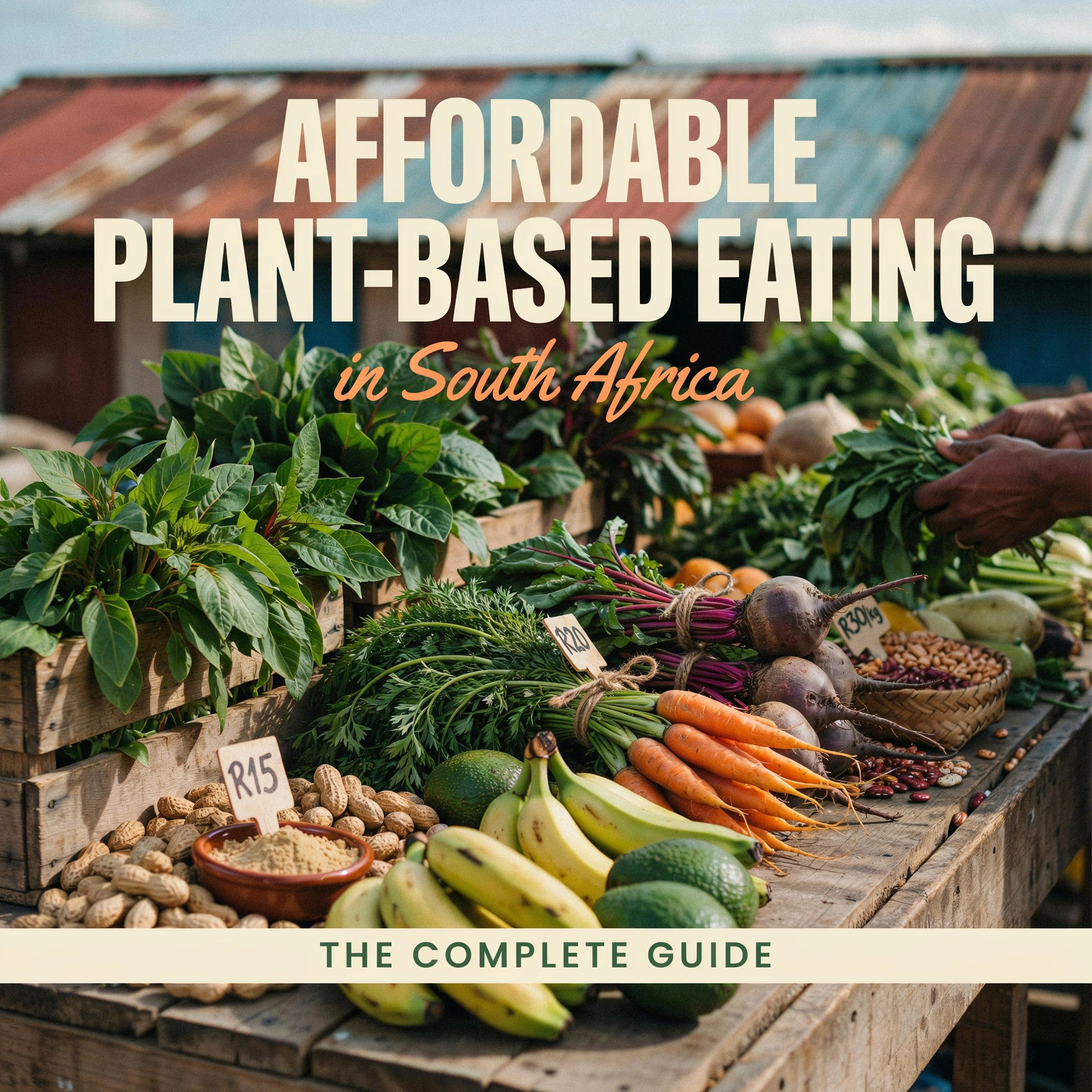
This is your guide to affordable plant-based eating in South Africa.
If you have stood in the supermarket aisle lately, calculator in your head, watching the trolley total climb while the trolley itself stays half-empty, you already understand the problem this guide solves.
Food is expensive in South Africa, and it keeps getting more expensive. Yet somewhere along the way, “eating well” got tangled up with imported chia seeds, R200 nut butters, and powders with names you cannot pronounce. The result is a quiet belief that plant-based eating is a luxury — something for people with money to burn.
I want to dismantle that belief, gently and completely.
I am a public health specialist, and I have spent years showing South Africans that the healthiest plates in this country are also the cheapest. Not despite being plant-based, but because they are.
The foods that have fed families across this land for generations — samp, dried beans, mealie meal, morogo, lentils, amadumbe — are nutritional powerhouses that cost a fraction of the trendy alternatives. This is the complete guide to eating that way on purpose: deliberately, affordably, and well.
By the end, you will know what the real cost of food is right now, which staples to build your kitchen around, how to get protein without the price tag, where to shop for less, and how to turn all of it into a week of satisfying meals. Let us begin.
The Myth That Plant-Based Eating Is Expensive
The myth comes from a simple visual confusion. When most people picture “plant-based,” they picture the wellness aisle: cold-pressed juices, imported berries, fortified faux meats, and seeds shipped halfway around the world. Those products are expensive.
But they are not what plant-based eating actually is. They are the marketing of plant-based eating — a thin, glossy layer sold to people who can afford to confuse novelty with nutrition.
Strip that layer away, and what remains is the oldest, cheapest, most sensible way humans have ever eaten: a bowl built on a starch you can buy in bulk, a legume that delivers protein for cents, and whatever vegetables are cheap and in season.
A pot of samp and beans does not need quinoa to be complete. A plate of pap and morogo does not need a superfood powder to be nourishing. The expense was never in the plants. It was in the packaging.
This matters because the confusion has real consequences. People hear “I should eat more plants” and assume it requires a budget they don’t have, so they give up before they even start. If you have ever felt that your wallet was crying at the till, you are not alone — and you are not the problem.
I unpack this exact frustration in Why Is Plant-Based Eating Important?, because the case for plants only holds up if ordinary people can actually afford it. The good news is that they can. They always could.
The Real Cost of Eating in South Africa Right Now
Let us ground this in numbers rather than feelings.
Every month, the Household Affordability Index tracks the price of a basket of basic foods across cities, including Johannesburg, Durban, Cape Town and Pietermaritzburg. In mid-2026, the average cost of that household food basket sat above R5 400 a month — and that basket is not even nutritionally complete.
It is what families on low incomes actually manage to buy, not what they would buy if money were no object.
To put a floor under it, Statistics South Africa calculates a national food poverty line — the bare minimum needed to meet daily energy requirements — at roughly R855 per person per month. Sit with that for a moment. Whatever you spend, you are spending it inside an economy where transport and electricity are paid first, and food is what gets squeezed afterwards.
Two lessons follow from these numbers. The first is that every rand of efficiency matters; small changes to how you build a plate compound can add up to real money over a month.
The second is more hopeful: the families who survive this squeeze are already doing something clever. Researchers who study the affordability index have noticed a pattern — women on tight budgets buy the core staple foods first, so that nobody goes hungry and basic meals can always be made. That instinct is not a compromise. It is a strategy. And it happens to be the foundation of the most affordable plant-based eating there is.
Build Meals Around Staples First
Here is the single most useful mindset shift in this entire guide. Stop building meals around a protein centrepiece, the expensive thing you arrange everything else around, and start building them around an affordable staple.
The staple is the anchor; everything else is decoration. You can scale up or down depending on what is in the cupboard and what is cheap that week.
This is the logic behind what I call the Staple-First Method. You do not have to adopt it as a system to benefit from the principle. The principle is simply this: a kilogram of dried sugar beans or a bag of mealie meal can underpin a dozen different meals for the price of a single takeaway. When the staple carries the meal, the “expensive” ingredients become optional flourishes rather than non-negotiable costs. Suddenly, a R30 punnet of mushrooms is a treat that elevates a meal you could have afforded anyway, not the reason the meal happened.
It also solves the variety problem. People abandon budget eating because they get bored, and boredom feels like deprivation. But the same five staples can become Mexican, Indian, Italian, or proudly South African, depending on the spices and vegetables you add.
The base stays cheap; the personality changes. That is how you eat affordably for months without feeling like you are on a punishment diet.
The Affordable Plant-Based Pantry
If you stock the items below, you can make a nourishing plant-based meal almost any night without a special trip. None of these is imported, exotic, or fragile. They store for weeks or months, they buy in bulk, and they have fed this country for generations. Many of them are quietly extraordinary — I dig into the science of several in 5 South African Staples That Are Secretly Superfoods.
The energy staples (your meal anchors)
Mealie meal (maize) is the workhorse of the South African kitchen. As pap, phutu or stiff porridge, it is filling, cheap per serving, and endlessly adaptable. Choose a less-refined or “super” maize where you can for a little more fibre.
Samp — dried, cracked maize kernels — cooks slowly into something hearty and is the heart of umngqusho.
Sorghum (mabele) is an underrated indigenous grain, naturally gluten-free, rich in antioxidants, and excellent as a breakfast porridge.
Brown rice and oats round out the category when you want a change.
The protein legumes (your price-beating muscle)
Sugar beans and other dried beans are the best-value protein in the country. Lentils (brown, red, or split) cook quickly, require no soaking, and melt into stews and soups.
Split peas make thick, comforting soups for almost nothing.
Cowpeas (dinawa / imbumba) are an indigenous legume worth rediscovering.
Soya mince is dry, shelf-stable, and rehydrates into a familiar mince texture for a fraction of the cost of meat.
Peanuts — whole or as peanut butter — add protein, healthy fat and serious flavour.
The vegetables and extras (your colour and nutrients)
Morogo (indigenous leafy greens, including amaranth and wild spinach) is often free or nearly free, and outperforms many imported “superfoods” on nutrient density. Cabbage, carrots, onions, butternut and pumpkin are cheap, store well, and stretch a pot. Amadumbe (taro) and ordinary potatoes add bulk and comfort. Tomatoes, spinach and whatever is in season fill the gaps. Buy produce when it is cheap and in season — that single habit will lower your vegetable bill more than any coupon.
Here is a rough sense of value to make the point concrete. Treat these as approximate 2026 prices — they vary by store, region, and season, but the ratios are what matter.
| Staple | Approx. price | What it gives you | Meals it can anchor |
|---|---|---|---|
| Mealie meal (10 kg) | ~R90–R120 | Energy, fibre, very low cost per serving | Pap & morogo, phutu, breakfast porridge |
| Dried sugar beans (1 kg) | ~R35–R55 | Protein, fibre, iron — many servings | Samp & beans, bean stew, bean curry |
| Samp (1 kg) | ~R25–R40 | Slow-burn energy, very filling | Umngqusho, samp salad, samp bowls |
| Lentils / split peas (1 kg) | ~R40–R60 | Fast-cooking protein and fibre | Dhal, lentil bolognese, thick soups |
| Soya mince (per pack) | ~R20–R35 | Familiar mince texture, shelf-stable protein | “Mince” curry, cottage-style bakes, tacos |
| Morogo / cabbage / seasonal veg | often free–~R20 | Micronutrients, colour, volume | Sides, stir-fries, stretching any pot |
Run your eye down that table, and the conclusion writes itself: the cheapest items are also the ones doing the most nutritional work. That is not a coincidence. It is the whole argument of this guide in a single column.
Protein Without the Price Tag
“But where do you get your protein?” is the question every plant-based eater in South Africa learns to expect. The honest answer is reassuringly boring: from the same place most of the world’s population always has — beans, lentils, peas, grains, nuts and soya. The World Health Organisation’s healthy-diet guidance and our own South African Food-Based Dietary Guidelines both point in the same direction: eat dry beans, split peas, lentils and soya regularly. This is not fringe advice. It is official, mainstream, and free.
The trick to plant protein is variety across the day rather than perfection in a single meal. Pair a grain with a legume — samp with beans, rice with lentils, bread with peanut butter — and you cover your amino-acid bases without thinking about it. Your grandmother was doing complete-protein nutrition long before it had a name.
A few affordable protein anchors deserve special mention. Soya mince is the budget hero for anyone transitioning from a meat-heavy plate, because it slots into recipes you already know. Peanut butter is calorie-dense and cheap, which matters if you are doing physical work and need food that keeps you full.
And for a convenient, fortified option, FutureLife deserves a place on the shelf — I cover its nutritional profile in detail in The Health Benefits of Eating FutureLife Smart Food. If you eventually want to experiment with higher-protein meat alternatives, my guide on where to buy seitan in South Africa lists options. However, I would treat them as occasional upgrades rather than weekly staples on a tight budget.
Where and How to Shop for Less
Affordable eating is not only about what you buy — it is about how and where. The same kilogram of beans can cost wildly different amounts depending on the format and the shop.
Buy the staples in bulk.
Dried goods are where bulk buying pays off most, because they keep. A 10 kg bag of mealie meal or a large sack of beans has a dramatically lower price per serving than the small packets, and it does not spoil while you work through it. If the upfront cost is a stretch, consider splitting a bulk buy with a neighbour or family member and dividing it — a small act of community that quietly lowers everyone’s grocery bill.
Use markets, spaza shops and farm stalls for produce.
Fresh vegetables are often cheaper at local markets, street vendors, and farm stalls than in supermarkets, and they are usually more seasonal, which means they are fresher and cheaper at the same time. Morogo and other greens are sometimes available for next to nothing, or can even be foraged or grown. Build your produce shopping around what is abundant that week rather than a fixed list, and let the prices guide the menu.
Shop online strategically
Online grocery shopping has changed the game for comparing prices and avoiding impulse buys — you can fill a basket, see the total, and trim before you pay. It also saves transport costs and the temptation of the snack aisle. I keep an up-to-date breakdown of the best platforms and how to use them in The Definitive Guide to Online Stores in South Africa (2026 Edition). Used well, online shopping is as much a discipline tool as a convenience.
Read the unit price, not the shelf price.
Train yourself to look at the price per kilogram or per 100 g, which is usually printed in small text on the shelf label. The “cheaper” packet is often more expensive per gram. This one habit will save you money on every single shop for the rest of your life.
A Week of Affordable Plant-Based Meals
Theory is comforting; a plan is useful. Below is a flexible framework for a week of plant-based eating built almost entirely on the pantry above. Treat it as a skeleton, not a prescription — swap the vegetables for whatever is cheap and in season, and scale the portions to your household and appetite.
Breakfasts (rotate freely)
Sorghum or oat porridge with peanut butter stirred through and a banana on the side. Mealie-meal porridge with a spoon of peanut butter for staying power. On busier mornings, a bowl of FutureLife with plant milk or water. These cost a few rand per serving and keep you full into the afternoon.
Lunches (cook once, eat twice)
Lunch is where leftovers earn their keep. Last night’s bean stew over rice. A samp salad with chopped tomato, onion and a squeeze of lemon. A thick lentil-and-vegetable soup with bread. Cooking slightly more dinner than you need is the cheapest lunch strategy in existence.
Dinners (the staple-first anchors)
Monday: Umngqusho — samp and beans slow-cooked together — with a side of fried cabbage.
Tuesday: Soya-mince curry with rice and whatever veg is on hand.
Wednesday: Pap with a tomato-and-onion gravy and morogo.
Thursday: Dhal (split peas or lentils) with rice and a quick cucumber salad.
Friday: Bean tacos or wraps with soya mince, shredded cabbage and a peanut or tomato sauce.
Weekend: A big pot of vegetable-and-bean stew, plus amadumbe or potatoes roasted with whatever spices you love.
To show how little this can cost, picture a single day. Breakfast is sorghum porridge with a spoon of peanut butter — a few rand. Lunch is yesterday’s leftover bean stew over rice — effectively free, because it was cooked in the same pot as last night’s dinner. Dinner is umngqusho with fried cabbage — samp, beans, and a quarter of a cabbage — again, only a few rand per serving once you have bought the staples in bulk. Three satisfying, protein-adequate, fibre-rich meals for the price of a single fast-food item. Stretch that arithmetic across a month, and the savings are not marginal; they are the difference between a budget that works and one that does not.
Notice the pattern. Five core staples — samp, beans, soya mince, lentils, mealie meal — carry an entire week, and the meals never repeat exactly because the vegetables and spices keep shifting. If you want a deeper dive into ultra-low-cost dinners specifically, I broke down how to eat well for very little in How to Eat Plant-Based in South Africa for R50 a Night. For more meal ideas and full recipes, my recipe index is the place to browse.
Batch Cooking and Stretching the Rand
The kitchen habits below are where good intentions turn into actual savings. None of them requires special equipment — just a little planning.
Cook legumes from dried, in batches. Tinned beans are convenient, but you pay heavily for the water and the can. Soak and cook a large pot of dried beans at once, then portion and freeze (or refrigerate for a few days). You will have “instant” beans at a fraction of the price of tinned beans.
Make the pot stretch. A handful of lentils or extra vegetables turns one pot of stew into two meals. Bulk is your friend on a budget — volume keeps people satisfied, and legumes and vegetables add volume cheaply.
Cook once, eat twice (or thrice). Deliberately overcook dinner so that lunch is already handled. The energy and time you spend cooking are themselves a cost; spreading one cooking session across several meals lowers that cost.
Waste almost nothing. Vegetable trimmings become stock. Stale bread becomes croutons or breadcrumbs. Slightly soft vegetables go into the soup. In a country where food is this expensive, throwing food away is throwing money away.
Season generously. Spices are cheap per use, and they are the difference between a meal you look forward to and one you endure. A well-spiced pot of beans costs almost as much as a bland one but tastes like a completely different, far more expensive meal.
Eating With the Seasons and the Regions
One of the most reliable ways to lower your food bill costs nothing to learn: buy produce when it is in season. Seasonal vegetables are cheaper. They are abundant and fresher because they have not been stored for months or shipped across the country. When you let the season write part of your menu, affordability and quality arrive together.
In the cooler months, lean on the hardy, storable vegetables that anchor a warm pot — butternut, pumpkin, cabbage, carrots, onions, potatoes and amadumbe. These are exactly the vegetables that suit slow-cooked stews, soups and bakes, which is convenient, because that is what you feel like eating when it is cold anyway. In the warmer months, tomatoes, spinach, green beans, peppers and a wider range of leafy greens become cheap and plentiful, lending themselves to lighter stir-fries, salads and quick sautés. Morogo, depending on where you live, can be available for very little throughout much of the year.
Regional eating helps too. Whatever grows well near you tends to be cheapest near you, because it has travelled the shortest distance. In KwaZulu-Natal, that might mean amadumbe and a generous supply of greens; in the maize belt, it might mean exceptionally affordable mealie meal and samp. Rather than fighting your region’s strengths by chasing ingredients that must be imported, build your staple base around what your area produces in abundance. It is cheaper, fresher, and it keeps money circulating closer to home.
The practical habit that ties this together is flexibility. Walk into the market or open the online store with your staples already decided and your vegetables undecided, then let the prices choose. A loose plan that bends to what is cheap that week will always beat a rigid shopping list that forces you to buy whatever a recipe demands, regardless of cost.
Common Mistakes That Quietly Inflate Your Budget
Even committed plant-based eaters leak money in predictable ways. Watch for these:
Chasing imported superfoods. Chia, goji berries, imported nut butters and exotic powders feel virtuous but deliver little that your local staples do not. Morogo, sorghum and beans cover the same nutritional ground for a fraction of the price.
Over-relying on processed meat alternatives. Plant-based burgers, fancy faux chicken and the like are genuinely useful for transitioning, and they have a place. But they are among the most expensive items in the plant-based world. Keep them as occasional treats, not weekly staples.
Buying small packets. Convenience packaging carries a steep premium. Bulk dried goods almost always win on price per serving.
Letting food spoil. Buying fresh produce you do not get to before it wilts is one of the most common ways money disappears. Buy what you will realistically use, and lean on hardy vegetables (cabbage, butternut, onions) that last.
Shopping hungry and unplanned. A loose, impulse-driven shop is an expensive shop. A short list built around your staples is a quiet act of financial self-defence.
Eating Well for Less Is a Form of Stewardship
I want to close the practical section with something a little bigger than rands and recipes. There is a quiet dignity in feeding yourself and your family well without overspending. It is good stewardship — of your money, of your health, and of the food traditions that were handed to you. The staples in this guide are not a downgrade from “real” healthy eating; they are real healthy eating, and they happen to be the inheritance of this land.
When you build a meal around samp and beans, you are doing three things at once: you are eating in a way that protects your long-term health, you are protecting your household budget, and you are honouring a way of eating that long predates the wellness industry’s attempt to sell it back to you at a markup. That is not deprivation. That is sovereignty over your own plate.
Frequently Asked Questions
Is plant-based eating really cheaper than eating meat in South Africa?
Yes, when it is built on staples rather than processed alternatives. Dried beans, lentils, samp, and mealie meal provide protein and energy at a much lower cost per serving than meat or fish. The exception is heavily processed plant-based products — faux meats and imported superfoods — which can cost more than meat. Build around whole staples, and the savings are substantial.
How do I get enough protein on a plant-based budget?
Lean on legumes (beans, lentils, split peas, cowpeas), soya mince, peanuts and grains, and combine a grain with a legume across the day — rice and lentils, samp and beans, bread and peanut butter. South Africa’s own dietary guidelines recommend eating dry beans, split peas, lentils and soya regularly for exactly this reason.
What are the cheapest plant-based foods in South Africa?
Mealie meal, dried sugar beans, samp, lentils, split peas, soya mince, cabbage, seasonal vegetables and morogo are consistently among the cheapest and most nutritious options. Bought dried and in bulk, they cost only a few rand per serving.
Do I need supplements on a plant-based diet?
The one supplement worth discussing with a clinic or pharmacist is vitamin B12, which is difficult to obtain from plants alone. Most other nutrients are well covered by a varied diet of staples, legumes, vegetables and fruit. For anything specific to your own health, speak to a healthcare professional rather than relying on a blog.
How do I start without it feeling overwhelming?
Start with one staple-first meal a week and build from there. Cook a pot of samp and beans, notice how cheap and satisfying it is, and let confidence grow from the plate rather than from a plan. For the bigger picture, my Comprehensive Guide to a Plant-Based Lifestyle in South Africa walks through the transition step by step.
Your Next Step
Affordable plant-based eating in South Africa was never a fantasy reserved for the wealthy. It is the most natural, traditional, and sensible way to eat in this country — you have to ignore the marketing and trust the staples. Build your meals around an anchor, keep a few cheap legumes and grains on hand, shop with intention, and cook in batches. Do that consistently and you will eat better, spend less, and feel more in control of both your health and your budget.
If you found this useful, keep going. Grab my free Whole-Food Plant-Based eBook for recipes and a starter framework, then explore the related reading below. One affordable, plant-based meal at a time — that is how this is built.
Keep reading
- How to Eat Plant-Based in South Africa for R50 a Night
- 5 South African Staples That Are Secretly Superfoods
- Staple-First Method Plant-Based Eating in South Africa
- Why Is Plant-Based Eating Important?
- The Definitive Guide to Online Stores in South Africa (2026 Edition)
- Comprehensive Guide to a Plant-Based Lifestyle in South Africa
By Zama Zincume, a Durban-based wellness educator and author championing indigenous Southern African foods—morogo, amadumbe, samp, sorghum—through EatingPlantBasedZA.com and his Staple-First Method™. His books make whole-food, plant-based living affordable and culturally grounded, framed within a “Sovereign Living” approach to health, mindset, and faith-based stewardship.
1 thought on “Affordable Plant-Based Eating in South Africa: The Complete Guide”